

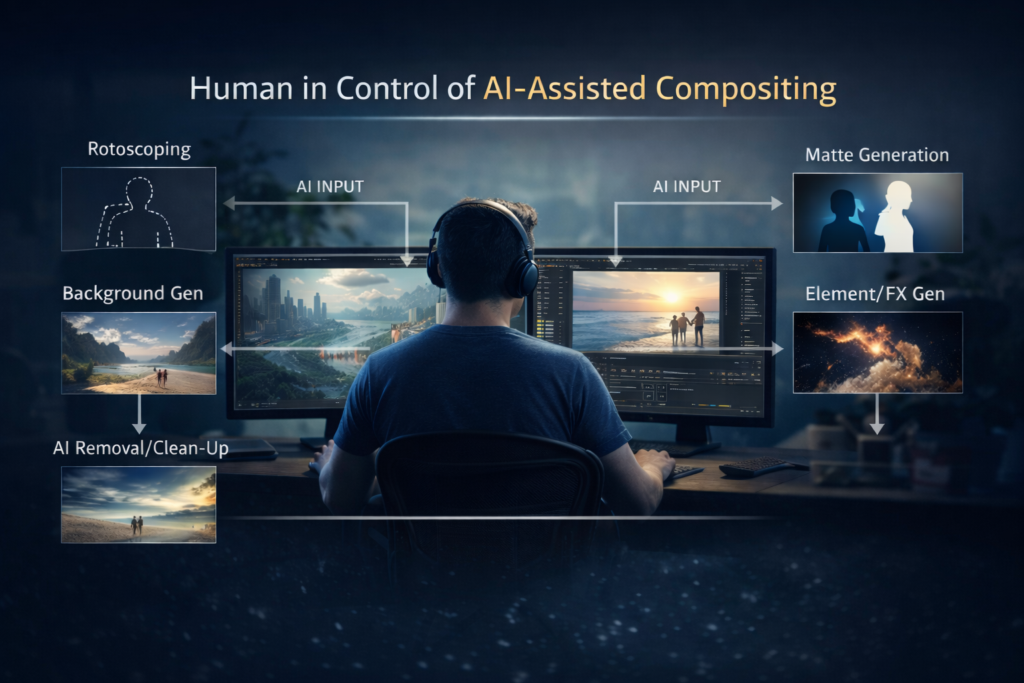
In modern VFX pipelines, AI’s real strength is not creative replacement but industrial-scale acceleration. Tasks that once absorbed weeks of artist time—rotoscoping, clean-ups, plate prep, segmentation, background generation—can now be executed in hours. This shift allows AI to handle the bulk of the work: the heavy lifting that gets a shot 90–95% of the way there. That efficiency gain is transformative, but it also highlights a critical truth—AI rarely finishes a shot.
The Difference Between Completion and Quality
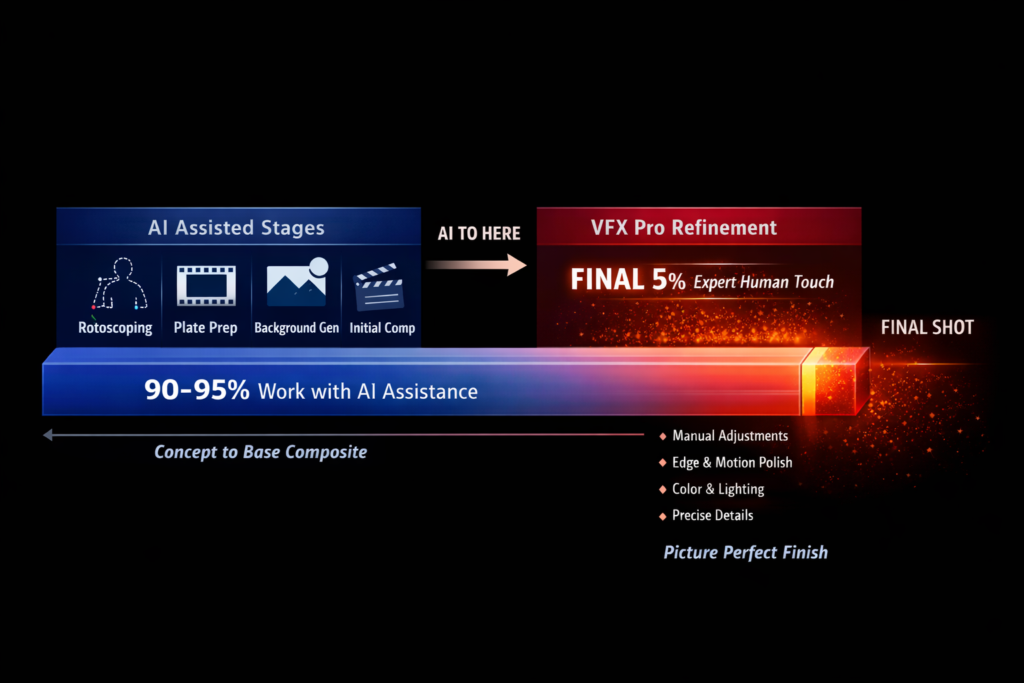
The final 10–5% is where experience matters most. This is the stage where motion nuance, edge integrity, temporal consistency, and artistic intent must be judged frame by frame. A seasoned VFX professional understands when a matte “feels” wrong even if it technically tracks, or when an AI-generated element breaks continuity across a cut. These decisions rely on taste, context, and production knowledge—areas where AI still lacks true understanding.
AI-generated content used in isolation also introduces a major limitation: iteration. Most AI outputs are destructive by nature. If a change is required, the common solution is to regenerate the asset entirely, often losing previous refinements and introducing new inconsistencies. This brute-force approach is inefficient and creatively restrictive.
Clever operators avoid this trap by treating AI output as raw material, not a finished product. Instead of relying on a single monolithic generation, they break AI results into modular segments—foreground, background, mattes, motion layers, textures— and rebuild them inside a traditional compositing environment. By refining these components separately, artists regain full non-destructive control. Adjustments can be isolated, versions compared, and changes made without resetting the entire process.
In this hybrid workflow, AI becomes a force multiplier rather than a replacement. Speed comes from automation; quality comes from judgment. The most effective pipelines don’t fight AI’s limitations—they design around them, ensuring that the final frame is shaped by human experience, not just machine output.